
PAL describes speech interaction, touchscreen content and a web interface for customising speech and gestures.
Source 1○ Not tested by ROBODROMO yetHumanoids
PAL Robotics ARI
A social robot with a screen and expressive body for visitor information and research. It suits managed settings, rather than unsupervised care or household assistance.
MotionTwo head joints, four per arm and a two-degree-of-freedom mobile base.Manufacturer source
Display10.1-inch 1200 × 800 touch display and two eye screens.Manufacturer source
ComputeConfigurable Intel i5/i7/i9; optional Nvidia acceleration.Manufacturer source
ConnectivityDual-band Wi-Fi, Ethernet and USB expansion.Manufacturer source
Recorded specifications, with their source limits. These are not our measurements. See all specifications and configurations
Price and availability
No current delivered price or availability has been confirmed here. Ask for a dated quote for the exact package.
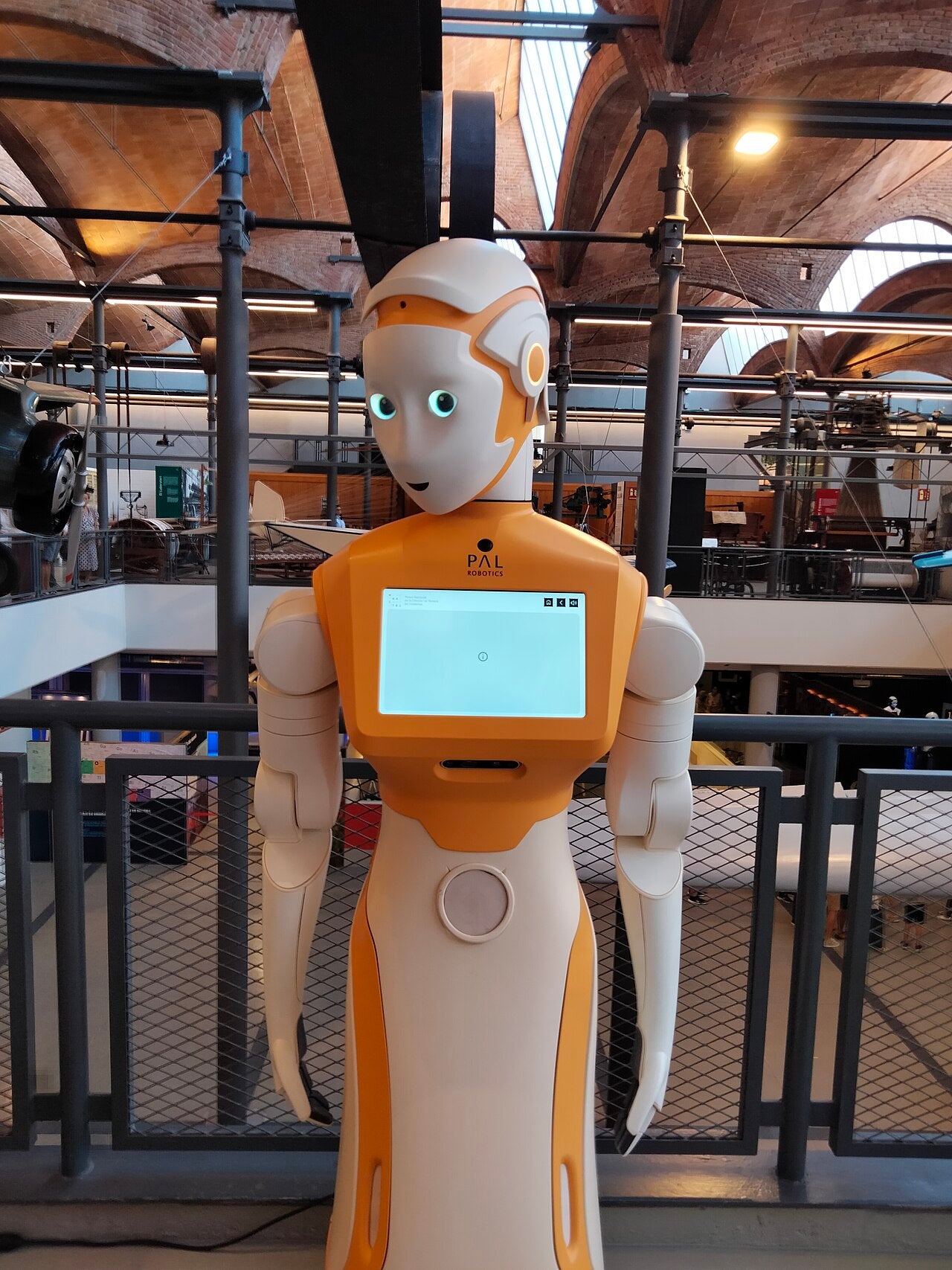
Image and credit
ARI photographed at MNACTEC in Terrassa in 2026. This museum installation may differ from the configuration offered today. Photograph: Enric. Original photograph · CC BY-SA 4.0. Resized for display; no other changes.Test track0 attempts run
We have not physically tested this robot. The task plan below is a starting point, subject to the exact unit and supported functions.
See the proposed test trackOn the ROBODROMO
test track
Three proposed tasks. Ten attempts at each suitable task, with the outcome, time and human help recorded. Confirm the exact robot, software and safe setup first. These tasks are not evidence that this robot can do them.
Complete one supported service task
Proposed task. 0 of 10 attempts run.
Repeat with a second supported destination or input
Proposed task. 0 of 10 attempts run.
Restart the task and record all operator help
Proposed task. 0 of 10 attempts run.
Pick a square to see what each attempt will record.
We will record the outcome, time, control mode, human help, safety stops, exact hardware and software, conditions and full video.
Proposed attempt; not run Only proceed if the exact unit supports the task and the setup is suitable. Keep remote control, scripted operation and autonomous operation separate. A completed attempt alone does not prove autonomy.What each square will show
Finished without extra helpNeeded a person’s helpFailedNot run yet
Keep the conditions visible
Name the control mode, surface, object or prompt and every intervention. Ten attempts are an initial result, not proof of long-term reliability.
Read our proposed test methodHow much do we really
know?
Separate our own tests from published claims and the limits of the evidence. The counts below describe records, not performance or confidence scores.
Tested by ROBODROMO
We have not physically tested this robot. No performance score or measured attempt is available.
See the proposed test track01 / The assessment
What the evidence supports.
Capability and readiness are separate. These written findings are not a numerical rating or a physical test.
Capability
What can it actually do?
ARI is relevant to the library as a platform for studying how people interact with robots. Its touchscreen and expressive body offer more than a static information display. The current evidence does not establish an unsupervised carer, a therapeutic benefit or dependable household assistance.
Read the source-based assessmentReadiness
Could you use it in real life?
Intended use: Visitor information and guided interaction. Dependable everyday use has not been established by the evidence reviewed. Respect the manual's flooring, stairs and supervision limits. Expressive interaction does not establish an unsupervised care role.
Read the source-based assessmentA clear limit
This is a research profile based on the sources below, not a hands-on test. Maker claims remain attributed to the maker; they do not prove repeatable performance in your home or workplace.
02 / Can it actually do it?
The claims, with their context.
The wording below keeps each source’s limits. A demonstration, a maker’s claim and a repeatable real-world result are different things.
The hardware guide lists four degrees of freedom per arm and optional Jetson computing and LiDAR. These are configuration-dependent descriptions, not a list of equipment guaranteed on every ARI.
Source 2The manual restricts operation to dry, flat indoor flooring and requires adult supervision for children under 13. It warns that the RGB-D camera will not detect downward stairs and says battery replacement is for official service personnel.
Source 3The emergency stop cuts motor power, allowing the head and arms to drop; computers and sensors remain powered. This is a documented operating limitation, not a tested safety verdict.
Source 3The edge-branch manual says clear small floor objects before navigation, keep people and pets at least 0.5 m away while moving and do not leave pets unattended. Check applicability to the installed robot and manual revision.
Source 3Check the original sources
Every source keeps its original check date. Manufacturer information, research configurations and independent observations have different limits.
Open the source listKnow the exact robot
The name alone may not tell you which hardware, software or support you get. Keep editions and optional equipment separate.
Specifications and configuration
Technical reference
Specifications and configuration
The figures and features below come from the named sources. They are not independent measurements. Optional hardware and conflicting revisions are kept separate.
| Item | Documented detail | Evidence |
|---|---|---|
| Interaction interfaces | PAL describes speech interaction, touchscreen content and a web interface for customising speech and gestures. | Source 1 |
| Arms and optional hardware | The hardware guide lists four degrees of freedom per arm and optional Jetson computing and LiDAR. These are configuration-dependent descriptions, not a list of equipment guaranteed on every ARI. | Source 2 |
| Operating restrictions | The manual restricts operation to dry, flat indoor flooring and requires adult supervision for children under 13. It warns that the RGB-D camera will not detect downward stairs and says battery replacement is for official service personnel. | Source 3 |
| Display | 10.1-inch projected-capacitive touchscreen, 1,200 × 800; two LCD eyes with custom animations. |
Maker source 31 Oct 2026 |
| Computing options | Intel i5/i7/i9; RAM options 8/16/32 GB. Xavier NX or Orin GPU is optional. Confirm the quoted build. |
Maker source 31 Oct 2026 |
| Audio | Two 30 W full-range speakers and a four-microphone array. |
Maker source 31 Oct 2026 |
| Networking | Dual-band 802.11ax Wi-Fi and 1000 BaseT Ethernet. |
Maker source 31 Oct 2026 |
| Documentation ambiguity | The hardware table prints “265GB” for its lowest SSD option and “40VAh” for a battery value. Those unusual entries are unresolved and are not silently corrected here. |
Maker source 31 Oct 2026 |
An omitted measurement has not been verified; it does not mean zero or unsupported. Check the exact hardware edition and documentation before ordering or designing around it.
Two head joints, four per arm and a two-degree-of-freedom mobile base.
Manufacturer source10.1-inch 1200 × 800 touch display and two eye screens.
Manufacturer sourceConfigurable Intel i5/i7/i9; optional Nvidia acceleration.
Manufacturer sourceDual-band Wi-Fi, Ethernet and USB expansion.
Manufacturer sourceEight–twelve hours claimed, configuration-dependent.
Manufacturer sourceThe exact model and configuration
The exact model
Meet PAL Robotics ARI
Keep ARI separate from PAL’s manipulation robots and distinguish the installed hardware from optional sensors and computing. The hardware documentation inspected belongs to the PAL OS edge branch, whose banner distinguishes stable and ROS 1 documentation. A page describing software support does not prove every existing ARI can use that configuration.
Further assessment notes
Evidence and practical use
Robodromo assessment
Desk assessment: 31 October 2026. Source-check dates: 2026-10-27, 2026-10-31.
Respect the manual's flooring, stairs and supervision limits. Expressive interaction does not establish an unsupervised care role.
- What the evidence describes
- ARI is relevant to the library as a platform for studying how people interact with robots. Its touchscreen and expressive body offer more than a static information display. The current evidence does not establish an unsupervised carer, a therapeutic benefit or dependable household assistance.
- Human help and setup
- Distinguish professional installation from routine staff work and exception recovery. No staffing reduction is inferred.
- What remains uncertain
- No observed conversation or navigation task assessed. Battery runtime language does not establish cognitive autonomy or unattended readiness. Exact software/hardware compatibility and application data handling remain unresolved.
- Readiness
- Intended use: Visitor information and guided interaction. Dependable everyday use has not been established by the evidence reviewed. Respect the manual's flooring, stairs and supervision limits. Expressive interaction does not establish an unsupervised care role.
This is an assessment of documented evidence, not a Robodromo physical test. Unresolved evidence does not mean the robot cannot perform the task. Source material has not been freshly rechecked for this publication.
Supporting sources
Setup, support and daily use
04 / Living with it
Right robot, right expectations.
What ownership could involve
A visitor-information trial should measure whether people get the right answer and can complete their task, rather than simply whether they enjoy meeting the robot. Record language, background noise, touchscreen fallback and staff intervention. Before deployment, establish the exact application, sensor package and software branch. Ask what recordings leave the robot, how long they are retained and who controls deletion; a general privacy label cannot answer those deployment-specific questions. Obtain current service, battery replacement and regional supply terms. No checked price or delivery promise is recorded here. The manual’s constraints make site layout and supervision part of ownership, not optional extras.
Support, software and repairs
PAL publishes hardware APIs, setup and support documentation. The page spans several compute/sensor options and contains an unclear battery unit (“40VAh”); request the exact configuration sheet rather than assuming capacity. Match PAL OS stable versus edge and ROS 1 versus ROS 2 documentation. Confirm service agreement, battery spares and supported software lifecycle.
Questions still open
What needs checking before you decide.
- No observed conversation or navigation task assessed.
- Battery runtime language does not establish cognitive autonomy or unattended readiness.
- Exact software/hardware compatibility and application data handling remain unresolved.
See it in action
Our filmed attempts will appear after testing. Existing footage below keeps its original description and limitations.
See the robot
PAL Robotics - Social Robot ARI
Play video
Published by PALRobotics. This presentation shows the named robot. Demonstrated functions and accessories may depend on the configuration and software version.
Before you buy
Get these answered in writing by the seller. Tick them off as you go.
0 of 6 answered
Your checklist records your progress. A tick is not verification by ROBODROMO.
Sources and checks
A check date tells you when a source was read. It does not mean every claim, price or offer is unchanged today.
Sources and checks
03 / Recorded evidence
The latest checks on file.
Dates below describe the recorded checks. They do not mean the manufacturer’s page was checked today.
- pal-robotics.com Source checked 2026-10-27
- docs.pal-robotics.com Source checked 2026-10-27
- docs.pal-robotics.com Source checked 2026-10-27
-
Manufacturer specifications and support
Exact-model specification/support passages in official source; numerical claims are manufacturer figures.
Source checked 2026-10-31 -
Video and publisher attribution
YouTube title and publisher checked against the named model. Not watched in full; not an independent performance assessment.
Source checked 2026-10-31
No recorded sources in this filter.
How sure are we?
5 linked sources. Read the claims and their limits below. A source count is not a confidence score.
Keep this robot on your radar.
Register your interest in this model and receive ROBODROMO’s robot updates.
We’ll record your interest. Personalised weekly alerts are not yet available. Privacy policy